


Kobus Lamprecht
Rode Publications & Media
Chief Economist
At the recent SAMRRA-hosted breakfast on Thursday, 22 January, Kobus Lamprecht opened his address with a warm welcome and sincere thanks to the organisers and delegates, noting the value of engaging directly with the market. He positioned the session as a practical, data-led overview of multifamily residential—an asset class gaining momentum in South Africa yet still lacking long-term, standardised performance benchmarking. Lamprecht framed his talk around two core realities: first, that property markets require disciplined interpretation rather than optimism or assumptions; and second, that credible, consistent research and reporting remain among the most important tools available to decision-makers.
“I’m very excited to be here,” Lamprecht said. “It’s great to connect with people and to share what we’re seeing in the market.”
SAMRRA is the industry body representing South Africa’s multifamily residential rental sector, bringing together institutional owners and specialist operators focused on professionally managed, purpose-designed rental housing. SAMRRA’s role is to support sector credibility, shared standards and improved market transparency through consistent measurement.
Rode Publications & Media is a long-standing, research-driven company, supported by exceptional property data collected and analysed over the past four decades. This depth of historical insight—combined with current market surveys—enables Rode to track real trends, identify turning points, and provide credible benchmarks across cycles. As the multifamily sector grows, this capability becomes increasingly valuable, enabling the sector to move from “market narrative” to measurable performance.
The Rode/SAMRRA collaboration: building the missing dataset
The partnership between Rode and SAMRRA has been established to provide consistent, consolidated tracking of South Africa’s multifamily residential sector, giving the market a clear and reliable view of performance over time. SAMRRA launched in February 2024, and in August 2025 Rode Publications & Media and SAMRRA announced a project to track members’ portfolios on an ongoing basis.
The first step was to align multifamily reporting with Rode’s established apartment surveys, initially focusing on vacancy rates and rentals, with capitalisation rates added in the second round. The long-term objective is to build a reliable quarterly time series that enables investors to see what is happening in real time, access consistent, credible data, and make better-informed decisions.
This matters because South Africa faces a persistent shortage of affordable housing, and expanding the supply of professionally managed rental stock is one of the most practical ways to respond.
As multifamily accommodation grows, it is also forming a distinct and investable asset class—one that can attract long-term institutional capital, support improved housing delivery, and strengthen the rental market through scale, consistency, and professional management.
Defining multifamily residential
Multifamily residential property represents privately owned residential stock designed for rental rather than sale. Properties are typically owned by institutional investors and managed by specialist operators. This asset class is characterised by large-scale rental supply, which can provide consistent, long-term income for investors.
Multifamily residential assets commonly include apartment buildings with multiple separate housing units within a single complex or estate. Units may be side-by-side or stacked (top-and-bottom). This single-owner/professional-operator model distinguishes multifamily from fragmented apartment ownership, where reinvestment, standards and management can vary widely. A multifamily complex typically includes facilities such as gyms, swimming pools, on-site maintenance teams and excellent security.
A changing market requires stronger fundamentals, not louder opinions
A changing market requires stronger fundamentals, not louder opinions. Lamprecht noted that the property sector is experiencing ongoing shifts — not only in pricing and performance, but also in how fundamentals are shaped by the broader economy.
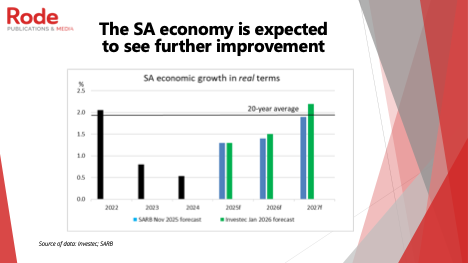
Against this backdrop, he argued that consistent benchmarks and reliable intelligence are more valuable than ever. While the economic narrative is cautiously constructive, with South Africa’s outlook expected to improve further, key capital-market indicators, such as bond yields, remain critical, and listed property sentiment has strengthened—supported by interest rate cuts, improving property fundamentals, and higher gold and platinum prices.

The message, however, remained balanced: the upswing is meaningful, but stakeholders should avoid “boom-time” assumptions.

Vacancy levels and what they signal
A further market fundamental he referenced was vacancy, which he noted is a powerful indicator of demand strength, oversupply, and node performance. In his remarks, he pointed to vacancy levels and emphasised that they are essential touchpoints when assessing whether a market is tightening or weakening.
“Vacancy tells you what’s happening on the ground,” Lamprecht said. “It’s one of the key indicators we monitor.”
This aligns directly with how the Rode Reports are used: vacancy is not just a number but a signal that informs leasing strategy, pricing decisions, and long-term feasibility planning.
Rentals, comparability and decision-grade benchmarks
Lamprecht repeatedly returned to the idea that the market needs reliable benchmarks for rentals and pricing, and that reporting supports comparable decision-making across nodes and property types.
“You need to know the rentals,” he said. “You need to know what’s happening across different areas, and you need a consistent view.” For example, it has also significantly expanded its rental coverage for apartments by including SAMRRA rental data for JHB, PTA, and CPT, by suburb.
Sample size and coverage: meaningful market representation
The survey has already covered the multifamily sector for three quarters. For context, Rode’s apartment survey for 25Q4 covered roughly 60,000 units, with SAMRRA members comprising a meaningful portion of the broader sample. Importantly, around two-thirds of apartments are located in suburbs, and about one-third are in CBDs, mainly in Johannesburg and Pretoria, enabling valuable location-based comparisons.
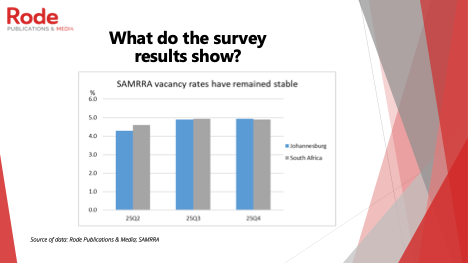
In 25Q4, the SAMRRA multifamily apartment block vacancy rate was approximately 5%, outperforming non-SAMRRA vacancy rates. The difference is partly structural: non-SAMRRA stock is often smaller-scale and privately managed, with owners holding only a few units or properties, whereas SAMRRA multifamily portfolios are typically single-owner assets, making management more efficient and consistent—particularly in areas such as maintenance execution and tenant marketing. SAMRRA multifamily stock is also generally more modern and amenity-rich, supporting stronger tenant attraction and retention.
A practical example is the Legacy Apartments venue, where the event was hosted, which features a gym, swimming pool, cinema room, and dedicated “work-from-home” spaces. Lamprecht emphasised that this multifamily dataset is still in its infancy and will be expanded and refined over time to provide even more reliable, decision-useful insights for the market.
What the early results show: vacancies differ, and location matters
The early results highlight differences in vacancy rates between SAMRRA multifamily portfolios and privately managed apartments, and show that outcomes are shaped by portfolio strategy, modern product quality, management intensity, tenant profile, and node selection. Kobus’s presentation tested whether CBD vs. suburban positioning affects performance and reinforced the value of Rode’s city- and suburb-level rental benchmarks for interpreting multifamily results.

Why this matters to investors and the industry
While multifamily assets remain a relatively small asset class in South Africa, the sector is becoming more investable and measurable. With the Rode/SAMRRA collaboration establishing consistent quarterly data, the sector is moving towards stronger transparency, better benchmarking and better decision-making—supporting institutional owners, operators, lenders and valuers as multifamily scales.
For more information about the Rode Report or to subscribe, please contact Jenni McCallum at jenni@rodemedia.co.za