

The latest SAFMA conference, held at the Kleinkaap Boutique Hotel, Centurion, 25-26 March 2026, united industry leaders, policymakers, and practitioners for two days of engagement, reflection, and strategic alignment — culminating in a renewed sense of direction for the sector, a restructured leadership framework, and a clear message that facilities management must seek its rightful place at the centre of the built environment.
A welcome grounded in purpose
Good morning, esteemed guests, industry leaders, partners, and facilities management professionals… Batabile Sibaca, SAFMA’s President, set the tone in a way that felt both familiar and quietly meaningful. There was the expected acknowledgement of time and commitment, the recognition that everyone in the room had stepped away from demanding operational roles, but there was also something more considered beneath it.
This was not presented as a standard industry gathering. Instead, SAFMA positioned the conference as a collaborative space for potential, a chance to step back from daily routines and ask deeper questions about the future of facilities management and how it must adapt to stay relevant.
The theme “a journey to excellence” was more than just a slogan. It reflected an industry in transition, one that is increasingly expected to move beyond maintenance and operations into the realms of strategy, performance, and long-term value creation.
From association to movement
As the programme progressed, a clear narrative began to emerge, one that positions SAFMA not just as an industry organisation but as a catalyst for change in the built environment.
There was a clear emphasis on professionalisation, on raising standards, and on building a more structured and recognised industry. But equally important was the recognition that facilities management itself has changed.
No longer confined to operational oversight, it now sits at the intersection of: asset performance, sustainability and ESG outcomes, digital systems and data and increasingly, investment decision-making. This shift was not presented as aspirational; it was described as already underway.
A critical shift: Bringing FM into the room earlier
One of the most compelling and widely repeated messages across the conference was the need to reconsider where facilities management fits within the project lifecycle.
For too long, FM has been introduced at the end of the process — after buildings are finished, systems are installed, and operational challenges have already become part of the asset.
The conference challenged this approach directly. There was a growing consensus that facilities managers should be part of the initial professional team, alongside architects, engineers, and quantity surveyors — not an afterthought, but a key contributor from the outset.
The reasoning is both practical and strategic. When facilities management is involved early, buildings are designed with maintainability in mind, lifecycle costs are better understood and managed, and sustainability targets are more achievable while operational efficiency becomes an integral part of the design rather than a retrofit.
It is a shift that requires not just recognition, but a redefinition of the role itself.
A programme anchored in reality
The strength of the SAFMA Conference 2026 programme lay in its ability to connect high-level thinking with practical application.
Rather than staying in the realm of theory, sessions consistently returned to three central questions: What is changing? What is working? And what comes next?
The first day opened with a strong macro lens, linking public sector policy and economic outlooks to the realities of infrastructure delivery. Discussions on energy efficiency, cost optimisation, and asset performance highlighted the growing importance of data in decision-making.
As the day unfolded, the focus moved towards implementation. Discussions about SMMEs, sustainability, and municipal infrastructure brought the conversation closer to real-world issues, emphasising both opportunities and ongoing challenges within the system.
Technology was a recurring theme, especially in sessions exploring AI and its practical use in facilities management. What stood out was not the novelty of the technology but the focus on usability — on how these tools lead to measurable results.
The inclusion of student research presentations added an important dimension, signalling an industry that is starting to take its future talent pipeline more seriously.
Day two expanded the discussion further, introducing themes of urban development, infrastructure financing, and long-term asset value. The role of FM in public-private partnerships, as well as its contribution to future cities, reinforced the idea that the discipline is broadening its scope.
By the time the programme concluded, the underlying message was clear: facilities management is no longer just a supporting function — it has become a strategic layer within the built environment.
A leadership reset
Against this backdrop, the announcement of SAFMA’s newly restructured board at the Gala Awards dinner held particular significance. This was not presented as a routine governance change, but as the outcome of a deliberate reassessment — one aimed at aligning leadership with the industry’s evolving needs.
New portfolios were introduced. Existing ones were redefined. Importantly, positions were opened to the market — an acknowledgement that the expertise required to advance the industry may not be confined to current structures.
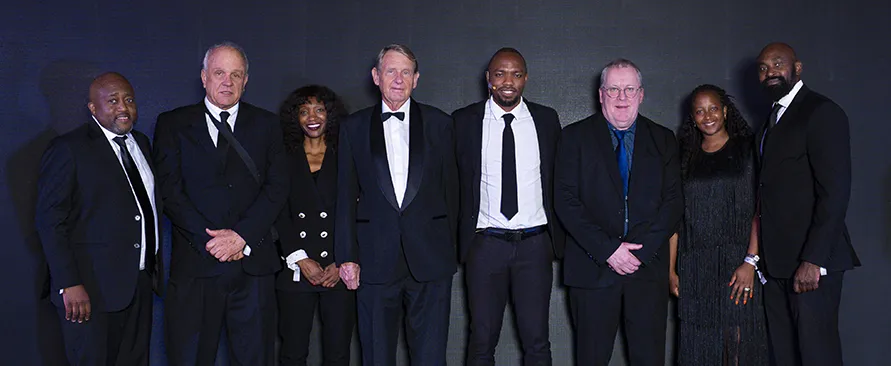
Left to right: Sipho Mazibuko, Johan Burger, Jacobeth Chikaonda, John Samuel, Batabile Sibaca, Hendrik Wannenburg, Lerato Mompati and Zodak Olinga
The new SAFMA board
Executive Leadership
President: Batabile Sibaca
Vice President: Johan Burger
Treasurer: Jocobeth Chikaonda
Core Portfolios
Governance: John Samuel (acting Director)
Innovation and Technology: Hendrik Wannenburg (acting Director)
Education and Training: Lerato Mompati
Sustainability: Zadok Olinga
Stakeholder Relations: Sipho Mazibuko
Aligning leadership with industry needs
The board structure reflects key industry priorities. The appointment of Lorato Mompati signals a renewed focus on education and pipeline development, while Zadok Olinga strengthens ESG integration.
Meanwhile, Sipho Mazibuko highlights the importance of Stakeholder Relations.
Extending capacity through an advisory committee
A key structural development announced at the conference was the establishment of a formal advisory committee.
Recognising the depth of expertise within the broader industry, SAFMA has created a platform to integrate this knowledge into its strategic processes.
The advisory committee will: engage with the board on a quarterly basis, contribute to strategy, governance and methodology and support decision-making through industry insight
Confirmed members include:
Sibusiso Nkabinde
Steven Molloy
Rowland Gurnell
Nathanial Reddy (former SAFMA president)
Jeanette Manana
Nirvani Singh
Ronald Barnard
A presidency defined by delivery
It is in this context that Sibaca’s leadership becomes central to understanding where SAFMA, and by extension the industry, is heading.
Stepping into an inherited structure
Sibaca is not a man merely marking time. When he was appointed president in September 2024, he stepped into an organisation that was already in motion. The board had been constituted. The strategy was underway. The methodology had been defined.
His first conference, held shortly afterwards, reflected that reality. “It wasn’t mine yet,” he says. “But it gave me perspective.” That early period, by his own account, was less about influence and more about observation — understanding what SAFMA was doing, but perhaps more importantly, what it was not doing.
Seeing the gaps clearly
Sibaca identified a pattern rather than a single issue. Smaller enterprises have limited access to the FM market. SAFMA has minimal influence in government procurement processes. Training pathways exist but are not leading to employment. Despite its scale, the profession itself lacks formal recognition.
He describes this not as failure but as inherited work — a set of challenges that called for deliberate intervention. “I’m not here to warm a seat,” he says. “I’m here to deliver.”
A five-pillar strategy for industry transformation
At the core of Sibaca’s presidency is a five-pillar strategy, designed to address long-standing structural gaps while positioning FM as a central player in South Africa’s built environment.
Bringing SMMEs into the FM Economy
One of the most significant interventions has been the deliberate inclusion of SMMEs, which have historically been marginalised in FM procurement. Sibaca will soon introduced a dedicated SMME membership band within SAFMA, lowering barriers to entry and creating a framework for collaboration with larger FM firms.
“Smaller enterprises were never meaningfully included in procurement. We are changing that, structurally and intentionally,” he says.
This is more than just symbolic inclusion. It signifies a move towards developing a supplier ecosystem, where smaller players are supported, integrated, and scaled within larger service delivery models.
Repositioning SAFMA in the Public Sector
Sabaca recognised early that SAFMA lacked significant influence in government procurement and infrastructure planning.
His response: strategic alignment with public sector stakeholders, including entities such as:
Department of Public Works and Infrastructure and the Development Bank of Southern Africa.
Through these engagements, SAFMA is moving towards formal participation in procurement frameworks — a development that could significantly change how FM services are commissioned. A key advancement is the proposed proof-of-concept (POC) model, where selected FM companies — both large and small — will have the opportunity to showcase integrated solutions across government buildings.
Says Sibaca, “We aim to move away from long, fragmented procurement cycles. This model enables us to demonstrate value, swiftly and effectively.”
Skills development and education reform
A recurring challenge in the FM sector has been the disconnect between training pipelines and workplace absorption. While funding exists — particularly through structures like Services SETA — placement opportunities have lagged.
Sibaca’s approach tackles this gap directly. Revamping SAFMA’s education portfolio, driving workplace integration for learners and promoting structured career pathways
Critically, SAFMA is now advancing discussions surrounding formal undergraduate FM qualifications at South African universities, a milestone that would greatly elevate the profession. “We are moving from awareness to structured education, from informal pathways to recognised qualifications.”
Grassroots development and industry awareness
Beyond tertiary education, Sibaca’s strategy encompasses early-stage exposure to target school leavers and young people. By raising FM awareness at grassroots level and establishing independent chapters, SAFMA is building a foundation for a sustainable talent pipeline. This approach demonstrates a broader understanding: FM is not just a support function, but a career pathway with technical, strategic, and leadership potential.
Strategic stakeholder engagement and MOUs
The final pillar emphasises formal partnerships, with SAFMA actively seeking Memorandums of Understanding (MOUs) with key institutions. These include public-sector infrastructure bodies, skills development agencies, and built-environment organisations. Announcements are expected in the near term, signalling a shift from dialogue to institutional collaboration.
Opening the door to government
If the SMME challenge exists at the lower end of the market, the public sector represents the opposite end — where scale, policy, and procurement intersect. Here, Sibaca found SAFMA largely absent. “There was no real alignment, no real opportunity to influence how tenders were structured.” His approach has been methodical: build relationships first, then formalise them.
This has included engagement with the Department of Public Works, the DBSA and other institutions, with MOUs currently in progress.
One of the most significant developments to emerge from the conference is a proposed proof-of-concept model with Public Works, where SAFMA will be directly involved in delivering FM solutions across selected government buildings.
It is, as Sibaca describes it, a shift away from process-heavy procurement towards demonstrable delivery. “Once it works, and it will, SAFMA will have a larger role in the procurement process.”
Closing the skills gap
The issue of skills development, meanwhile, is one that Sibaca approaches with evident urgency. While training structures are in place, the gap between education and employment remains substantial.
There were learners, but no absorption. Part of the problem lies in awareness, especially regarding incentives like ETI. However, it is also structural, with a misalignment between what is being taught and industry requirements.
His response has involved changes at the board level, along with a renewed focus on building relationships with universities and training institutions.
The long-term goal is clear: to develop a pipeline that is both continuous and linked to genuine opportunity.
The council question and professional recognition
If there is one goal that stands above the rest, it is the pursuit of formal council recognition for facilities management. “Once FM has a council, that’s the game changer,” Sibaca says.
This ambition is now more than just theoretical. A significant development, and one that holds real significance within the built environment, is that during the conference, the quantity surveying profession effectively endorsed SAFMA and gave the association the green light to pursue formal council recognition.
For Sabaca, this is a crucial moment. It marks a shift from advocacy to advancement, from arguing for recognition to actively working towards it.
Obtaining council status would not only enhance the profession’s reputation but also integrate it into the official frameworks of the built environment, providing facilities management with a clear regulatory and professional identity.
It would also formalise something the conference repeatedly emphasised: that facilities management is not an auxiliary function, but a core discipline that contributes directly to asset performance, lifecycle value, and long-term sustainability.
From participation to influence
This ambition directly links to one of the most significant shifts discussed at the conference, the necessity for facilities management to be involved at the conceptual stage of projects.
“If we are brought in at the end, we are fixing problems,” Sibaca says. “If we are brought in at the beginning, we are shaping outcomes.” This is not simply a technical adjustment. It is a repositioning of the discipline itself.
Leadership with a defined endpoint
Perhaps the most notable aspect of Sibaca’s leadership style is his perspective on tenure.
Now, roughly two and a half years into his presidency, he is clear that the role is not meant to be indefinite. “This is not about holding the position for as long as possible,” he says. Instead, his focus is on completing his objectives — on ensuring that the structures he has put in place are fully realised.
“When the foundation is in place, and the organisation is positioned correctly, that’s when my job is done.” It is a perspective that prioritises accountability over longevity, and outcomes over position.
A defining window
“What we do in the next three to five years will define this industry,” he says.
It is a statement that captures the essence of the SAFMA Conference 2026. The industry is at a turning point. The structures are beginning to change. And the role of facilities management is being redefined in real time.
Under Sibaca’s leadership, SAFMA is not merely responding to that change. It is attempting to shape it.
And the winners were;
Innovation in Facilities Management;
Gold: Michael Thackwray – Discovery
Christiaan Meyer – Growthpoint Properties
Web Meko – Bidvest Facilities Management
Silver: Jeremiah Klaas -Bluestone Africa Pty LTD
Webb Meko, Bidvest Facilities Management
Bronze: Jimmy Kgalushi – Empact Group
Best FM Service Provider
Silver: Webb Meko – Bidvest Facilities Management
Sibusiso Nkabinde – Servest Pty LTD
Leadership in Facilities management
Silver: Sean Meyer – Growwthpoint Properties
Vicky Morarjee – Tsebo Facilities Solutions
Community Impact Award
Bronze: Thabang Mbembele – Pro-Serve Group
Health Safety and Wellness Initiative of the Year
Bronze: Candice Carrie Botha – Tsebo Facilities Solutions
Sustainability Champion of the year
Gold: Andrew Vorster – Growthpoint Properties
Webb Meko – Bidvest Facilities Management
Women in Facilities Management Recognition Award
Bronze: Nolusindise Mclean – Empact Group
Platinum: Jacelyn Jensen – Life Healthcare Group