

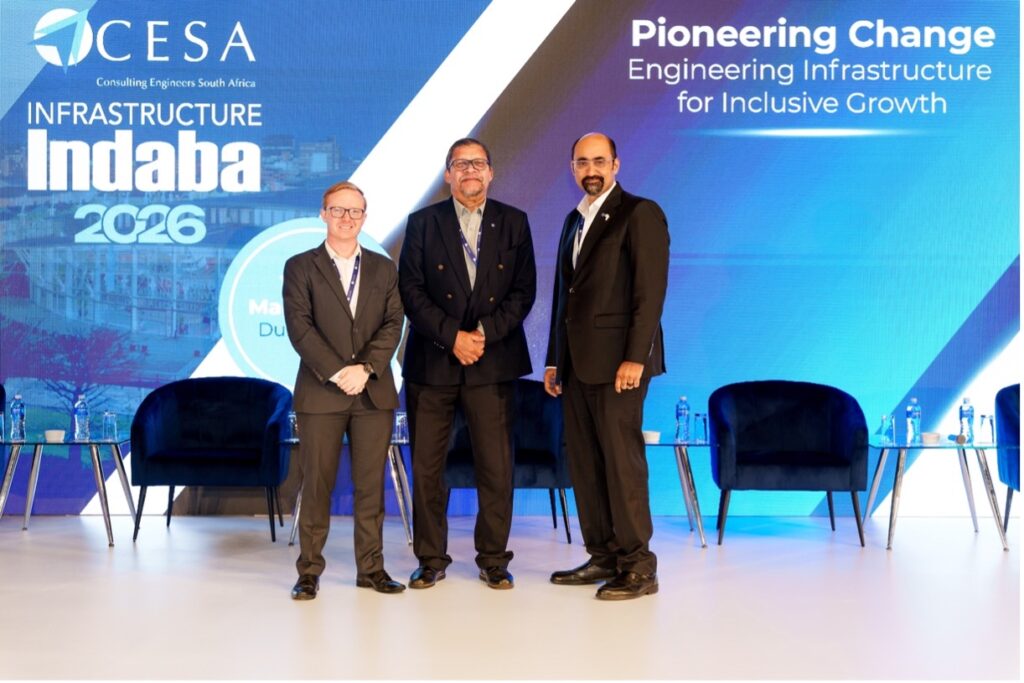
Executive Mayor of uMngeni Local Municipality Chris Pappas, CESA CEO Chris Campbell and CESA President Dr Vishal Haripersad
The second day of the Consulting Engineers South Africa (CESA) Infrastructure Indaba 2026, being held at the Durban International Convention Centre (ICC), zeroed in on water and rail as critical building blocks for South Africa’s economic growth.
The proceedings began with an insightful and reassuring address by the Executive Mayor of uMngeni Local Municipality, the Honourable Chris Pappas, who discussed issues surrounding linking national infrastructure to local economic realities.
While infrastructure is often aligned with national priorities, the crucial connection to local economic needs is often ignored, restricting its real effectiveness.
“We must plan, otherwise our reality will always be in catch-up mode. Infrastructure should not be reactive; it must be proactive, shaping where people live, where businesses invest, and how economies evolve,” Pappas added. “Futureproofing is not just building better, but building smarter, more resilient, and sustainable. Planning today for the future ensures infrastructure can adapt, endure, and continue to deliver long-term value.”
Speaking during a session titled ‘Building Tomorrow’s Infrastructure’, Moshe Motlohi, Chief Executive of Transnet Rail Infrastructure Manager (TRIM), stated that opening South Africa’s rail network to new operators will unlock much-needed capacity and reduce pressure on South Africa’s road network. He also outlined how new Train Operating Companies (TOCs) will be introduced on 41 routes across six corridors.
“Through our Open Access Process, these new entrants expect to move about 25 million tons of cargo from road back onto rail,” he stated.
However, Motlohi warned that “deteriorating levels of asset reliability and availability result in safety risks, train delays, cancelled train slots, volume loss and eventual permanent capacity loss,” emphasising that current affordable funding levels fall significantly short of what is needed to maintain and renew the network over the next five years. If this funding gap is not addressed, infrastructure will continue to deteriorate, capacity will be limited, and national rail volumes will decline further below demand.
Private investment and new rail capacity
Delegates heard that public reform is starting to attract private capital. Earlier this week, private rail company TRAXTION confirmed a R3.4 billion investment programme in rolling stock to support this reform agenda. The programme, comprising R1.8 billion in locomotives and R1.6 billion in wagons, is the largest private freight rail investment in South Africa’s history in terms of fleet size and value, aiming for a minimum of 60% local content and expected to generate 662 direct jobs during manufacturing, assembly, and deployment.
The increased TRAXTION capacity is expected to cover about 5% of the national freight rail shortfall, providing a tangible boost to efforts to rebalance freight from overburdened roads to more efficient rail routes. TRIM’s recent Requests for Proposals for leases at sidings such as Ngagane near Newcastle, Krugersdorp, and Klaserie near Hoedspruit further indicate a shift towards a more open, multi-operator rail sector.
Securing the rail backbone
Motlohi stressed that operational recovery will not be possible without tackling security risks that have plagued the network since the Covid-19 lockdown period, when the Railway Safety Regulator documented record levels of theft and vandalism of vital assets such as rail lines, signalling components, and overhead traction equipment. Nationwide, cable theft and infrastructure vandalism are believed to cost major state-owned entities, including Transnet, Eskom, and PRASA, approximately R7 billion annually in direct losses.
TRIM is therefore strengthening a layered security strategy centred on five core pillars: deter, detect, delay, defend, and deny. This includes a more visible security presence, improved surveillance to identify potential threats early, measures to physically slow intrusions and protect critical assets and personnel, and stricter controls to prevent unauthorised access to the network.
Dr. Gift Mphefu, MD, Med-Tech Engineers and CESA Board Member, chaired the session where Motlohi was joined by Phindile Nxumalo, Acting General Manager for Infrastructure from Transnet National Ports Authority (TNPA), and Dudley Mbambo, KZN Provincial Manager for SANRAL.
Water: the foundational risk
While much attention focuses on logistics and rail, water specialists at the Infrastructure Indaba warned that economic aspirations would remain at risk if South Africa’s water systems continue to deteriorate.
Duane Petersen, Director at G Afrika and Chair of CESA Western Cape Branch; Sydney Masha, Senior Manager of Water and Sanitation at eThekwini Municipality; Megan Schalkwyk, Process Engineer at uMngeni-uThukela Water; and Sagren Narasimulu, Managing Director at Makhaotse, Narasimulu and Associates (MNA), discussed water security in South Africa.
“When we discuss infrastructure that supports economic growth, we often consider energy or transport. But in reality, water is the foundation,” said Schalkwyk.
Schalkwyk warned that much of the water infrastructure is failing or underperforming due to poor maintenance, citing the 2022 Green Drop Report, which revealed that nearly 40% of wastewater treatment works were in a critical condition and almost two-thirds posed a high or critical risk. As a water utility, uMngeni-uThukela Water is already experiencing the effects of declining raw water quality, which complicates and increases the cost of treatment and reduces reliability for households and industry.
Non-revenue water and economic waste
Non-revenue water has become another key issue, with losses caused by leaks, theft, and operational inefficiencies undermining both water security and local finances. In KwaZulu-Natal alone, an estimated 1,015 million litres of water were lost daily in 2023, with over 900 million litres of this representing actual physical losses such as leaks – meaning roughly 53% of the water supplied did not reach consumers’ taps.
Schalkwyk emphasised that water security depends not only on constructing more infrastructure but also on “planning better, maintaining what we have, diversifying our sources and working together more effectively”.
By enabling water security, we don’t just secure water; we also foster economic growth, resilience, and dignity for our communities,” she added, stressing that underperforming water systems can quickly undermine the benefits of investments in transport, logistics, and industrial infrastructure.
Storage, climate, and long-term resilience
Additionally, Narasimulu highlighted that South Africa’s freshwater storage remains a structural vulnerability in the face of climate variability. “Our challenges are not new, but their impact is becoming increasingly pronounced as urban growth and climate change become more prevalent,” he said.
With relatively few large dams, the system faces increasing pressure, restricting the country’s capacity to store enough water during wet seasons and maintain supply during extended droughts.
Technology and Innovation: Shaping the Future
Marizel Pienaar, Civil Engineer at Bigen Group and YPF National Chairperson, led the Indaba’s “Technology & Engineering Innovation” session, where Athini Pantshwa, Acting Senior Manager for Research, Testing, and Development at Eskom, discussed clean coal projects and Ishmail Cassiem, Director for Construction Industry Performance at the cidb, outlined the BIM roadmap, noting low adoption rates and plans for an annex and a National BIM Committee to boost implementation.
How the Future will be Financed
In the final session of the day, Vignesh Naidoo, AECOM Durban Infrastructure Civils Team Lead led a discussion by uMngeni Local Municipality Supply Chain Management Head Sanele Khomo and Development Bank of South Africa Group Executive for Infrastructure Delivery Division Chuene Ramphele, where they highlighted how strategic planning and smart investments were needed to ensure efficient infrastructure delivery.
“A central message at this year’s Indaba was that South Africa’s infrastructure decisions must be integrated, forward-looking and grounded in local realities, ensuring that investment in infrastructure is matched by serious attention to the water systems that ultimately underpin economic activity and community well-being,” CESA CEO Chris Campbell concluded.