

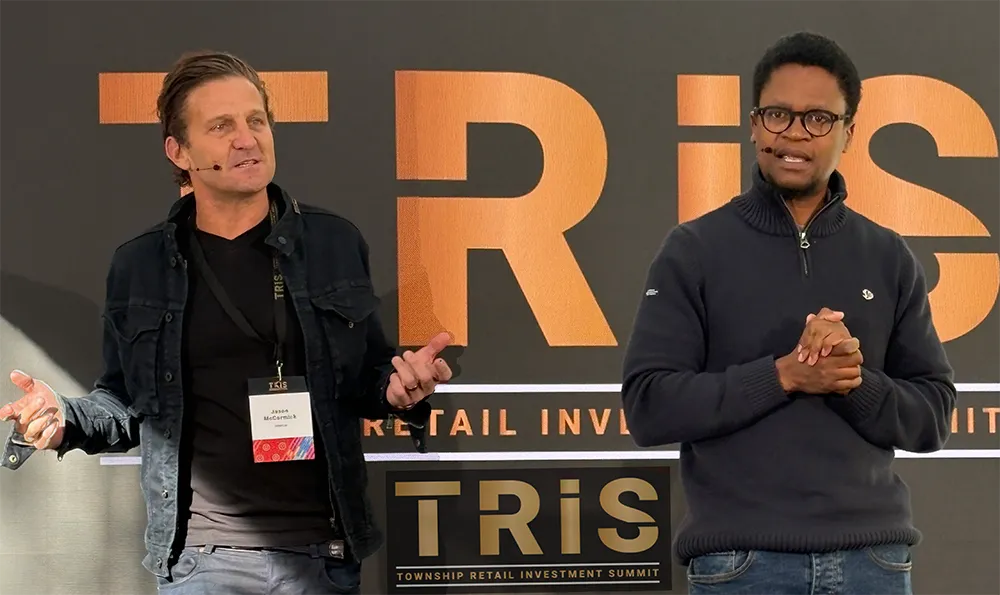
Jason McCormick, CEO, Exemplar REITail, MD, McCormick Property Development, with the founder of Wakanda NPC and Gcwalisa, Miles Kubheka
Education, entrepreneurship and the evolution of township economies
The Township Retail Investment Summit (TRIS) 2026, held at the Open Gallery in Sandton (14th May 2026), underscored the growing importance of South Africa’s township economy as a serious area for investment, innovation and economic participation. Over the past several years, there has been a recognition that township economies are no longer peripheral markets operating outside mainstream commerce, but rather highly active and interconnected ecosystems shaping the future of retail, entrepreneurship and community-driven growth in South Africa.
Founded in 2022 by entrepreneurs, developers, and township economy advocates, including Jason McCormick and Miles Kubheka, TRIS was established to bridge the gap among township entrepreneurs, retailers, investors, developers, brands, and policymakers. Initially positioned as a township retail and property discussion platform, the summit has evolved into a much broader collaborative ecosystem exploring the relationship between entrepreneurship, education, technology, digital inclusion, culture, infrastructure and local economic participation.
This year’s event brought together economists, entrepreneurs, researchers, educators, development organisations and retail strategists, each offering distinct perspectives on the opportunities and challenges facing township economies. The speaker line-up included Nicky Weimar, Chief Economist at Nedbank; Belinda Clur of The Clur Index; Stacy Saggers from Kantar; Mongezi Mtati of Rogerwilco; representatives from GoThrive, the Olico Maths Programme and Girl Unlimited; and entrepreneurs and development-focused organisations, including the UNDP.
A day of thought-provoking exploration of entrepreneurship, education and the rise of township innovation
Throughout the day, presentations and discussions flowed seamlessly between township consumer research, entrepreneurship, digital platforms, education, food safety, retail property, development finance and youth-led innovation. Despite the breadth of topics, a consistent message emerged across nearly every session: township economies are not waiting to be “discovered” or “saved.” They are already innovating, adapting and building sophisticated economic systems of their own. The real challenge for institutions and brands is whether they are prepared to understand these systems well enough to participate meaningfully within them.
One of the summit’s strongest themes centred on the idea that township economies function as fully interconnected ecosystems rather than isolated retail opportunities. Speakers described how economic activity flows fluidly between spaza shops, informal traders, taxi networks, food vendors, supermarkets, households and digital platforms. Transactions are often driven by trust, familiarity, social visibility and community reputation as much as by price or convenience.
Researchers presenting township consumer studies explained that many brands continue to approach township markets incorrectly, attempting to position themselves at the centre of the ecosystem rather than learning to become useful participants within it.
Consumer behaviour itself is also changing rapidly. Presentations highlighted growing supermarket penetration in township areas, rising adoption of online shopping, and greater reliance on WhatsApp and social media platforms to share promotions, specials, and retail information. Yet speakers repeatedly stressed that digital accessibility alone is not enough.
Township consumers continue to place enormous value on physical presence, accountability and visible community engagement. Brands are expected to demonstrate consistency, usefulness and long-term commitment to the communities they serve.
The role of women in township economies attracted significant attention throughout the conference. Researchers and panellists highlighted that women remain the primary decision-makers in many households, particularly regarding groceries, budgeting, food choices, store loyalty and product trust. However, speakers cautioned against treating women as a single, uniform market segment, emphasising that consumer priorities vary substantially by household structure, income, education and generational context.
Some of the day’s most impactful moments came from entrepreneurs sharing personal business journeys rooted in lived experiences in townships. These presentations illustrated how many successful township enterprises emerge directly from immediate community needs rather than from formal corporate planning structures. One entrepreneur detailed how personal hardship led to the creation of a sneaker-cleaning and restoration business that grew into a recognised enterprise employing multiple people. Another case study focused on a recycling business that converts used cooking oil into cleaning products while addressing waste management, environmental sustainability and local job creation.
These stories reinforced another key message repeated throughout the summit: township entrepreneurs often already possess the technical understanding, resilience and market knowledge needed for success. What many still lack is access to funding, mentorship, scalable operational systems and digital tools.
Education also emerged as a central theme. Presenters argued that education should increasingly support entrepreneurship, innovation and practical problem-solving, rather than serving solely as a pathway into traditional employment. Development organisations discussed how mentorship, enterprise incubation and skills development can help township residents build businesses that generate both income and broader community impact. Topics ranged from agricultural innovation and digital entrepreneurship to youth enterprise development and technology-enabled services.
Technology, connectivity and digital inclusion featured prominently throughout the day’s discussions. Speakers highlighted the growing importance of affordable data access, smartphone use, digital literacy and mobile-first business systems. Several presentations explored how platforms are now being designed around township consumer behaviour and affordability realities, with lightweight, low-data systems becoming increasingly important. At the same time, presenters warned against if digital transformation alone can solve structural economic challenges. Technology, they argued, must still align with community trust, cultural behaviour and existing social systems.
One of the summit’s most important conversations centred on the Dime initiative, a collaborative programme developed in response to food contamination incidents linked to township spaza shops. What began as a food safety intervention evolved into a much broader ecosystem project encompassing spaza shop digitisation, financial inclusion, digital education, community training and data gathering. Speakers explained that the initiative demonstrated how digital tools and data systems can help informal businesses become more visible, more compliant and ultimately more investable within formal economic structures.
The summit also explored themes of cultural intelligence and the concept of “Hebrism,” presented as a framework for understanding African consumer behaviour and economic participation through cultural context and identity. The discussion argued that many brands spend heavily on marketing because they fail to build products and services that are culturally embedded from the outset. Understanding language, identity, community behaviour and shared experiences was described as critical to building authentic relationships in township markets.
Retail property and shopping centre development were other key topics of discussion. Speakers challenged property owners to rethink the design and management of township retail environments, warning that formal retail expansion can unintentionally undermine surrounding informal economies if integration is not handled carefully. Several participants argued for more integrated retail ecosystems that incorporate informal traders, support small businesses and create pathways for local entrepreneurs to participate meaningfully in formal retail developments.
By the close of the event, the overarching message was clear: no single institution, company, or sector can unlock economic growth in townships on its own. Whether discussing entrepreneurship, food safety, youth unemployment, digital inclusion, informal trade or community development, speakers consistently returned to the importance of collaboration among government, private-sector brands, investors, educators, technology companies, development agencies and communities themselves.
TRIS 2026 ultimately reinforced a powerful reality: South Africa’s township economy is already innovating, adapting and evolving at scale. The question is no longer whether these economies matter, but whether institutions, investors and brands are prepared to engage with them seriously, respectfully and collaboratively to unlock their full potential.