


From left: Natasha Bruwer, David Pierre-Eugene, Nishi Sharma, Aubrey Mcelnea and Tunde Ojo-Aromokudu
World FM Day 2026 brought South Africa’s facilities management sector together around a theme that reached beyond infrastructure, operations and maintenance: Cultivating Belonging Through the Built Environment. Held at the University of Pretoria’s Future Africa Campus on 13 May 2026, the event explored how facilities management increasingly shapes not only buildings, but also the human experience within them.
Hosted by the South African Facilities Management Association (SAFMA), the gathering drew facilities managers, property professionals, service providers, public-sector representatives, workplace strategists, consultants and built-environment specialists into a day-long conversation about dignity, inclusion, sustainability, technology and professionalisation within FM. While operational excellence remained central, the dominant message throughout the day was that facilities management is ultimately about people.
Opening the event, Johann Burger, Vice President of SAFMA, positioned the profession as one of the most influential yet often under-recognised disciplines in the built environment. He argued that FM’s true purpose lies in creating environments where people feel safe, respected, productive and connected. Buildings, systems and maintenance programmes are simply the mechanisms through which that experience is delivered.
Burger also outlined SAFMA’s strategic priorities, which include strengthening leadership and governance, accelerating the professionalisation of facilities management, expanding education and professional development, broadening the association’s footprint and ensuring long-term sustainability for the profession. Central to this strategy is SAFMA’s continued push for formal recognition of FM as a professional discipline within South Africa’s broader built-environment landscape.
The event reinforced how far the profession has evolved. Facilities management is no longer viewed solely as a support function concerned with cleaning, maintenance and operational continuity. Increasingly, FM professionals are expected to influence organisational culture, workplace productivity, asset performance, sustainability outcomes and long-term strategic planning.
Recognition of excellence also formed part of the programme through the Global FM Awards, where Discovery received a Silver Award acknowledging its contribution to advancing facilities management practice. The recognition reflected the growing importance of FM leadership within large organisations and demonstrated how operational excellence can directly influence organisational performance and workplace experience.
One of the highlights of the day was the panel discussion titled “Can Belonging Be Designed?“ The Role of FM in Shaping Human-Centred Environments. Moderated by Natasha Bruwer of Broll Property Group, the session brought together voices from corporate real estate, facilities management, architecture and the public sector.
The discussion quickly moved beyond architecture itself and focused on the relationship between design intent, operational management and daily human experience. Panellists argued that belonging cannot be created through aesthetics alone. Instead, it emerges from how spaces are managed, maintained and experienced over time.
A recurring theme was the importance of listening to building users before making workplace decisions. David Pierre-Eugene from Discovery emphasised that facilities teams often assume they understand what occupants want without asking meaningful questions. He cited practical examples in which employees requested surprisingly simple improvements rather than expensive workplace interventions, reinforcing the importance of direct engagement and human-centred decision-making.
Architectural perspectives also featured strongly during the session. Tunde Ojo-Aromokudu stressed that effective human-centred design requires facilities managers, architects, operational teams and end users to participate in projects from the earliest stages. Without operational insight, buildings may achieve visual impact while failing to support practical day-to-day functionality.
The public-sector perspective provided another important dimension. Advocate Nishi Sharma from the Department of Public Works and Infrastructure highlighted the operational realities faced by government departments managing ageing buildings, constrained budgets and infrastructure never designed with lifecycle maintenance in mind. Her comments reinforced a broader industry concern: facilities management is still too often excluded from early design and planning stages.
Sharma argued that belonging within public buildings begins with fundamentals rather than luxury. Clean bathrooms, functional lifts, accessible entrances, safe public spaces and working air-conditioning systems all contribute to dignity and public trust. A poorly maintained building, she noted, can directly undermine service delivery, productivity and confidence in public institutions.
Maintenance itself emerged as one of the strongest human-centred themes of the day. Aubrey Mcelnea of Tsebo Facilities Solutions referenced the “broken window” theory, explaining that neglected maintenance signals a lack of care and gradually affects morale, behaviour and workplace culture. Deferred maintenance not only damages infrastructure, but it also influences how people perceive and value their environment.
The panel also explored the evolving role of workplaces in a hybrid, highly competitive employment environment. Organisations increasingly need to create spaces that employees genuinely want to occupy. Social rituals, shared spaces, informal interaction zones, and even seemingly simple workplace experiences, such as quality coffee areas or communal gathering spaces, were discussed as contributors to workplace belonging.
Biophilic design and wellness considerations formed another major discussion point. Panellists highlighted the positive impact of natural light, ventilation, greenery and outdoor connections on productivity and wellbeing. However, the emphasis was less on “green design” as a marketing tool and more on creating healthier, more human environments that support long-term occupant wellbeing.
Perhaps one of the strongest conclusions from the morning session was the industry-wide call for earlier FM involvement in projects. Panellists repeatedly argued that facilities managers possess unique operational insight into lifecycle costs, maintenance practicality and long-term building performance. Excluding FM professionals during design and feasibility stages often leads to inefficient buildings and significantly higher operational costs later.
Following the panel, delegates moved into structured networking and collaborative discussion sessions organised around six focused FM themes. Rather than conventional networking, the format encouraged practical engagement and solution-driven discussion across issues including leadership, sustainability, technology, professionalisation and public-private collaboration.
While the breakout sessions covered diverse topics, several clear themes emerged during the report-back discussions. Delegates consistently returned to the idea that belonging extends beyond physical space and is shaped by organisational culture, operational behaviour and emotional experience. Participants also highlighted the often-overlooked emotional burden borne by frontline operational staff who help create positive workplace experiences while facing significant day-to-day pressures.
Another important discussion centred on public-private partnerships and their potential role in improving service delivery across government infrastructure portfolios. Delegates explored how long-term PPP structures can strengthen operational accountability, improve maintenance outcomes and support local economic participation through job creation and skills development.
Technology and data management formed another major area of focus. Delegates acknowledged that many FM operations still rely on reactive maintenance approaches and disconnected reporting systems. Discussions highlighted the growing importance of integrated platforms, real-time operational data, and collaborative digital systems that can improve both operational efficiency and the workplace experience.
Professionalisation remained one of the dominant themes throughout the event. Delegates argued that facilities management still struggles with fragmented identity and insufficient recognition compared to other built-environment professions. Calls were made for stronger educational pathways, clearer professional positioning and expanded research partnerships with academic institutions.
Sustainability discussions reinforced the increasingly interconnected nature of FM responsibilities. Delegates explored how operational excellence and sustainability goals are no longer separate objectives. Energy management, water efficiency, renewable technologies, HVAC optimisation, and “as-a-service” operational models were presented as practical mechanisms to improve both resilience and long-term operational performance.
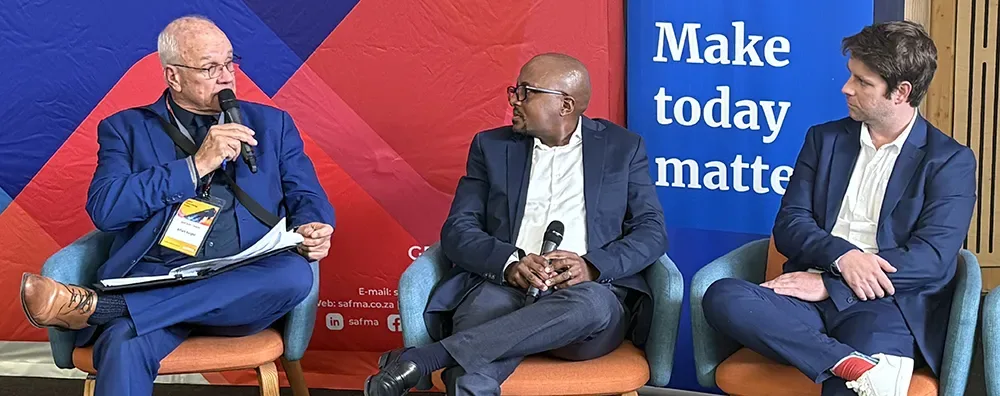
From left: Johan Burger, Bani Kgosana and Glen Huddy
The afternoon programme shifted towards technology, operations and human experience, with discussions focusing on how digital systems are reshaping modern FM practice. Speakers emphasised that technology should support people rather than replace them. Artificial intelligence, predictive maintenance systems, and integrated analytics platforms were discussed as tools that can improve visibility, planning, and operational performance while reducing administrative burdens on FM teams.
A significant operational focus was placed on asset registers, lifecycle planning and critical spares management. Speakers noted that sectors reliant on imported specialist equipment — including lifts, escalators, HVAC systems and electrical infrastructure — increasingly require sophisticated, data-driven maintenance and inventory strategies to reduce operational risk and avoid prolonged downtime.
The final session of the day introduced a research perspective through Stephen Molloy’s doctoral work on FM standards and ISO 41001:2018. Based on survey feedback from more than 100 FM professionals, the research examined awareness and implementation of standards across the sector.
Molloy argued that standards should not be viewed as rigid compliance mechanisms, but rather as frameworks for continual improvement, operational alignment and long-term organisational performance. His findings highlighted organisational culture, leadership support, financial limitations, skills shortages and poor data systems as some of the primary barriers to successful implementation of FM standards.
Importantly, the research also revealed encouraging signs for the profession’s future. South Africa’s FM sector appears to have a relatively strong pipeline of younger professionals, particularly within the 30-to-49 age group, creating significant opportunities for mentorship, knowledge transfer and long-term industry growth.
As World FM Day 2026 concluded, the broader message was unmistakable. Facilities management is increasingly positioned as a strategic profession operating at the intersection of people, technology, sustainability, operations and organisational culture. The discussions throughout the day reinforced that FM is no longer confined to the background of the built environment. It is becoming one of the disciplines most directly responsible for shaping how people experience workplaces, public infrastructure and shared spaces.
The event closed with a strong sense that the future of facilities management in South Africa will depend on collaboration, professional recognition, leadership development, technological maturity and a continued focus on creating environments where people feel valued, supported and connected.