

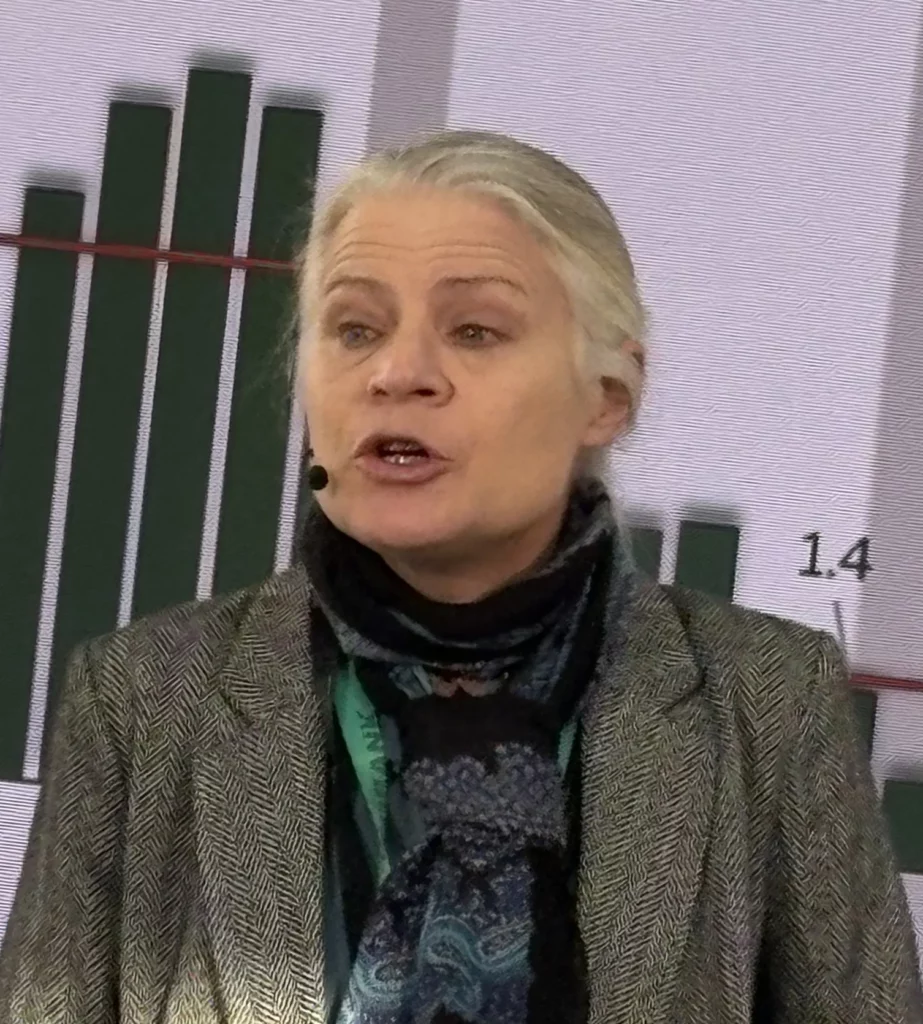
Nicky Weimer, Chief Economist at Nedbank, speaking at the TRIS 2026 Summit
South Africa’s economy is showing signs of recovery — but it remains a fragile and uneven recovery unfolding against a backdrop of rising global uncertainty, renewed inflation risks, and mounting pressure on energy markets.
That was the overarching message delivered by Nedbank Chief Economist Nicky Weimar at the Township Retail Investment Summit (TRIS) 2026, where she addressed investors, retailers, developers and property stakeholders on the forces shaping South Africa’s economic trajectory and the implications for consumers, retailers, landlords and investors alike.
At the heart of Weimar’s analysis was a simple but sobering reality: South Africa has improved, but it has not escaped its low-growth trap.
Growth is improving, but still weak
Weimar opened by contextualising South Africa’s current growth environment. GDP growth of between 0.5% and 1.1% may technically represent improvement, but for an emerging market economy battling unemployment, infrastructure backlogs and weak fixed investment, it remains far below the level needed to materially improve living standards.
“We are still caught in a low-growth trap,” she explained, pointing out that while the economy has stabilised, the pace of recovery remains slow.
Yet beneath the headline numbers, there are signs that parts of the economy have started to regain momentum. High-frequency economic indicators showed a noticeable acceleration in activity during the second half of last year, particularly in the final quarter, with continued support from retail sales and vehicle purchases moving into the opening months of 2026.
For the retail property sector — and particularly for township retail investors attending the summit — this matters enormously. Consumer spending remains the central engine of activity for shopping centres, hospitality environments and discretionary retail categories. And after several years of sustained pressure, households were beginning to show signs of recovery.
Why the consumer improved
Weimar identified three major forces that drove the consumer rebound: lower inflation, reduced debt-servicing costs and improved real disposable income.
Inflation dropped sharply to around 3%, creating an environment where even modest salary increases translated into genuine gains in purchasing power. At the same time, the South African Reserve Bank responded with 150 basis points of interest-rate cuts, easing pressure on indebted households.
“At one stage, households were spending 9.4% of their disposable income simply on servicing interest payments,” Weimar noted. “As rates came down, more money was freed up.”
The introduction of the two-pot retirement system added another temporary boost, allowing many consumers to access portions of their retirement savings. Combined, these factors created a short-term tailwind for retail spending and household consumption.
However, Weimar stressed that the recovery has not been evenly distributed across society.
Higher-income households, particularly those linked to assets, investment returns and profit income, recovered first and more decisively. Wage earners, grant recipients and small-business operators saw slower improvement, although conditions had started to stabilise after years of stagnation.
The key point, she suggested, is that South Africa is not experiencing a broad-based boom. Instead, the country is moving cautiously onto firmer ground after an extended period of economic weakness.
The consumer recovery remains fragile
Despite improving conditions, Weimar cautioned that the support underpinning the consumer recovery is beginning to weaken.
Savings rates remain extremely low, and the once-off stimulus effect from the two-pot retirement withdrawals is fading. While spending growth is expected to continue, it is likely to moderate as inflationary pressures re-emerge.
And it is the global environment — rather than domestic demand alone — that now represents the greatest threat to South Africa’s recovery.
Oil, conflict and the return of inflation risk
A major portion of Weimar’s presentation focused on rising geopolitical tension in the Middle East and the implications for global energy markets.
Central to the concern is the Strait of Hormuz, one of the world’s most strategically important shipping routes. Approximately 38% of global oil supply passes through the narrow channel, making it one of the most vulnerable choke points in the global economy.
Any disruption — whether through direct military conflict, shipping attacks or prolonged instability — would have significant consequences for global fuel prices.
“This is not a 12% supply shock like Russia,” Weimar warned, comparing current risks to the earlier Russia-Ukraine energy crisis. “The Middle East represents a much larger and less replaceable share of global oil supply.”
The impact is already being felt in diesel prices, which are particularly sensitive because Middle Eastern crude is a major component of global diesel refining feedstocks.
For South Africa, this creates a serious inflation risk.
Fuel is not merely a household expense; it is embedded throughout the economy. Diesel powers logistics, transport fleets, agriculture, mining operations and supply chains. Higher fuel prices, therefore, filter directly into operating costs across virtually every industry.
How energy inflation spreads through the economy
Weimar outlined what economists call the inflation transmission mechanism.
The first-round effect is immediate: higher petrol and diesel prices push up transport costs and headline inflation.
The second-round effect is more dangerous. As operating costs rise, businesses are forced to decide whether to absorb the pressure or pass it on to consumers through higher prices. Over time, those price increases begin feeding through the entire economy.
The Reserve Bank’s biggest concern is not simply that inflation rises temporarily, but that inflation expectations become entrenched.
If households begin expecting higher inflation in the future, wage negotiations, pricing behaviour and business planning all begin adjusting upwards. Once this happens, inflation becomes self-reinforcing and significantly harder to contain.
Historical data from both the post-pandemic inflation cycle and the Russia-Ukraine energy shock show how rapidly these expectations can shift. According to Weimar, consumer inflation expectations typically begin to rise within months of major oil price disruptions.
Food inflation may be the next pressure point
Weimar also highlighted the risk of rising food inflation, particularly through fertiliser costs.
Many fertiliser inputs, including urea and ammonia-based products, are closely linked to Middle Eastern energy production. Sustained energy disruption, therefore, has a delayed but meaningful impact on agricultural input costs and food production.
For now, South Africa remains relatively protected. Good harvests, improved crop production and easing livestock disease pressures have helped stabilise domestic food prices.
But if energy disruption persists, those pressures could begin filtering into food inflation during 2027 and beyond.
Reserve Bank likely to turn more cautious
Against this backdrop, Weimar believes the South African Reserve Bank will adopt a far more cautious approach to monetary policy.
Although inflation remains better contained than during the 2022 cycle, the Bank is unlikely to ignore rising fuel-driven price pressures.
Nedbank’s base case projects inflation averaging around 4.3% this year, rising above 5% during the second quarter before gradually moderating again. A full return to the Reserve Bank’s preferred midpoint target may only happen in 2027 or even 2028.
As a result, expectations for aggressive interest-rate cuts have faded significantly. Weimar indicated that the Reserve Bank may reverse a portion of its earlier easing — potentially increasing rates modestly if inflation risks intensify further.
For consumers, that means the environment is becoming more difficult again. The powerful combination of falling inflation, lower interest rates and temporary liquidity support that boosted spending over the past year is starting to fade.
The Rand has been surprisingly resilient
One area where South Africa has outperformed expectations is currency stability.
Despite elevated global volatility, the rand has remained relatively resilient. Weimar attributed this partly to weakness in the US dollar itself, as global investors reassess US fiscal and trade policy credibility, but also to genuine improvements within South Africa.
Electricity supply has stabilised. Logistics performance, while still problematic, has improved modestly. Fiscal consolidation efforts have strengthened investor confidence, and the Government of National Unity has introduced a more stable policy environment than markets previously anticipated.
“We move slowly,” Weimar acknowledged, “but the work has been done. Markets are rewarding that.”
The rand’s relative resilience has helped offset some imported inflation pressure and prevented the current oil shock from becoming even more severe.
Implications for retail and property
For retailers, landlords and property investors, the message is ultimately one of cautious realism.
Consumers are healthier than they were a year ago, but they remain vulnerable. Household income growth continues, but at a slower pace. Credit growth is increasingly shifting toward short-term and revolving debt rather than longer-term instalment finance — a sign that consumers are still managing pressure carefully.
Retail growth is expected to continue, but not at the pace many anticipated before global energy tensions escalated.
“Growth will be slower than we thought, but it will still be growth,” Weimar concluded. “The consumer is not disappearing. But the easy gains from falling inflation and falling rates are behind us.”
For the retail property sector, that means future performance will increasingly depend on operational excellence, pricing strategy, tenant mix, customer experience and value positioning rather than broad macroeconomic tailwinds alone.
South Africa’s economy, she concluded, is still moving toward higher ground — just more slowly, and with far greater global uncertainty than many had hoped only a few months ago.